
Stocks and ETFs
Discover a world of new opportunities by investing in shares of leading global companies
What are shares?
A share is a security that confirms an ownership interest in a company. By purchasing a share, an investor becomes a shareholder and gains the right to participate in the economic results of the business.
Return on shares may be generated in two main ways. The first is growth in the share price. If a company develops, increases profit, strengthens its market position and becomes more valuable to investors, the price of its shares may rise. The second is dividends. Some companies regularly distribute part of their profit among shareholders. Such payments are called dividends.
Shares are instruments with potentially high returns, but also with a high level of risk. The price of a share depends on the company’s financial results, the state of the industry, interest rates, inflation, currency factors, political events and general investor sentiment.
How did shares emerge?
The idea of equity participation in business appeared long before modern exchanges, but the classical stock market began to take shape in the 17th century. One of the earliest examples was the Dutch East India Company, which raised capital from many investors to finance trading expeditions. Investors received an interest in the company and expected to participate in its profits.
Over time, shares became a universal method of raising capital. Companies issued shares to finance development, construction of factories, expansion of trade, railways, banks, industrial projects and technological innovation. Exchanges, in turn, created an organised venue where such shares could be bought and sold.
Today, the stock market is one of the key elements of the global financial system. The world’s largest exchanges, including NYSE, Nasdaq, Japan Exchange Group, Euronext, Hong Kong Exchanges, London Stock Exchange and other venues, provide access to thousands of companies from different countries and sectors.
What types of shares are there?
Common shares give the investor the right to participate in the growth of a company’s value, receive dividends if declared and, as a rule, voting rights at shareholder meetings. This is the most widespread type of share on the public market.
Preferred shares usually grant priority rights to receive dividends, but may not provide voting rights or may limit them. Such shares often combine features of shares and bonds: they may provide a more predictable cash flow, but usually have lower growth potential compared with common shares.
Growth stocks are shares of companies that rapidly increase revenue, profit or market share. They often include technology, biotechnology and innovative companies. Their attractiveness is linked to high growth potential, but such shares may be especially sensitive to changes in interest rates and investor expectations.
Dividend stocks are shares of companies that regularly pay part of their profit to shareholders. These are usually more mature businesses with stable cash flows: banks, telecommunications companies, utilities, energy and consumer corporations.
Value stocks are shares of companies that, in the opinion of investors, trade below their fundamental value. This approach assumes analysis of profit, assets, debt burden, cash flows and comparative valuation against peers.
Companies are also divided by size. Shares of large companies are usually more liquid and stable, but their growth potential may be more moderate. Shares of small and mid-sized companies may grow faster, but usually carry higher risk and may be less liquid.
What is an ETF?
The main idea of an ETF is to give the investor simple access to a basket of assets. One ETF may include shares of hundreds of companies, government or corporate bonds, gold, commodities, an economic sector, a country index or the global market.
For example, an ETF on the S&P 500 index allows an investor to gain exposure to the largest public companies in the United States not by buying each share separately, but through one exchange-traded instrument. A bond ETF may provide access to a portfolio of government or corporate debt securities. A sector ETF may invest in technology, healthcare, financial or energy companies.
How did ETFs emerge?
ETFs appeared much later than shares. The first modern ETF was launched in Canada in 1990. In the United States, the ETF market began developing actively after the launch of SPDR S&P 500 ETF Trust in 1993, which became one of the best-known and most liquid ETFs in the world.
Initially, ETFs were used mainly to track broad stock indices. Over time, the market expanded: ETFs on bonds, commodities, individual countries, sectors, factors, dividend strategies, active management, money market instruments, currencies and other asset classes appeared.
Today, ETFs have become one of the fastest-growing segments of the global asset management industry. By the end of April 2026, global ETF assets had reached a record USD 21.91 trillion, confirming the scale and steady growth of this market.
What are the key features of ETFs?
The key feature of an ETF is diversification. One ETF may include dozens, hundreds or even thousands of instruments. This reduces the investor’s dependence on the performance of one individual company, although it does not eliminate market risk.
The second important feature is exchange trading. ETFs can be bought and sold during the trading session like ordinary shares. This makes them a flexible instrument both for long-term investing and for tactical asset allocation.
Transparency and costs are also important. Most ETFs regularly disclose their portfolio composition, and passive ETFs often have lower fees than traditional actively managed funds. At the same time, the investor should remember that the price of an ETF may decline together with the underlying asset or index.
What types of ETFs are there?
Sector ETFs invest in companies of a particular industry: technology, healthcare, finance, energy, real estate, industrials, consumer sectors and other areas.
Country and regional ETFs provide access to shares of a specific country or region: the United States, Japan, Germany, China, India, emerging markets, Europe or Asia.
Bond ETFs invest in government, municipal, corporate, high-yield or short-term bonds. They may be used to generate interest income, reduce portfolio volatility or manage liquidity.
Commodity ETFs provide access to gold, silver, oil, industrial metals or other commodity assets. Some of such instruments hold the physical asset, while others use futures contracts.
Dividend ETFs invest in companies that pay dividends or have a history of stable dividend growth. Factor ETFs are built around a specific investment characteristic: value, quality, low volatility, company size, price momentum or dividend yield.
Active ETFs should be highlighted separately. They do not simply follow an index, but are managed by a portfolio manager. There are also inverse and leveraged ETFs. These are complex and high-risk instruments that usually do not suit long-term passive investing.
On which markets are shares traded?
The United States is the largest and most liquid equity market in the world. The largest technology, financial, healthcare, consumer and industrial companies are traded there. NYSE is traditionally associated with the largest mature corporations, while Nasdaq is associated with technology and fast-growing companies. The advantages of the US market are high liquidity, a wide range of instruments, developed infrastructure, high transparency of reporting and a large amount of analytical coverage.
The London Stock Exchange is one of the historic centres of global capital. It lists British and international companies, including banks, commodity corporations, insurance companies, funds and depositary receipts of foreign issuers.
The European market provides access to companies from France, Germany, the Netherlands, Switzerland, Italy, Spain and other countries. It includes industrial groups, banks, pharmaceutical companies, luxury goods producers, car manufacturers, energy and infrastructure businesses.
Japan is one of the largest stock markets in the world. It includes global industrial, automotive, technology, financial and consumer companies.
The Hong Kong exchange is one of the main bridges between international capital and Chinese companies. It lists shares of companies from Hong Kong, mainland China and other Asian markets.
The Shanghai and Shenzhen exchanges provide access to companies from mainland China. This market is enormous, but it has a more complex access infrastructure for foreign investors. Access to Chinese equities is often obtained through special programmes, depositary receipts, funds or ETFs.
On which markets are ETFs traded?
The most developed and liquid ETF market is the United States. It is there that the largest ETFs, the narrowest spreads on many instruments, high order book depth and a large number of market makers are concentrated.
At the same time, it would be incorrect to say that liquid ETFs exist only in the United States. Europe has a large UCITS ETF market, with trading venues in London, Frankfurt, Amsterdam, Milan, Paris and Zurich. European UCITS ETFs are often used by international investors because of regulatory features, tax treatment and the availability of different currency share classes.
In Asia, ETFs are also developing, especially in Japan, Hong Kong, China, South Korea and Singapore. However, in terms of depth, diversity and level of liquidity, most Asian ETFs still lag behind the largest American and European funds.
The practical conclusion is that for maximum liquidity and minimal trading costs, investors often look to US ETFs, but for tax planning, currency structure and regulatory reasons, European UCITS ETFs may be more suitable for non-US residents.
How should an investor choose a market?
The first important factor is liquidity. It shows how easily an instrument can be bought or sold without significant impact on its price. For an investor, trading turnover, order book depth, fund size in the case of ETFs, the number of market makers and the size of the bid-ask spread are important.
The second factor is currency. The investor must take into account the currency of the instrument. US shares are traded in US dollars, British shares often in pounds sterling or pence, European shares in euros, Swiss francs or other currencies, Japanese shares in yen, Hong Kong shares in Hong Kong dollars. Even if the price of the asset rises, the result for the investor may change because of exchange rate movements.
The third factor is country risk. It includes political stability, quality of regulation, investor rights protection, independence of courts, sanctions risks, currency controls, tax predictability and the attitude of the state towards foreign capital.
It is also important to consider market accessibility for foreign investors. The United States, the United Kingdom and most European markets have developed infrastructure for foreign investors. China, India and some other markets may require special access channels, may have ownership restrictions or settlement peculiarities. Sometimes it is easier for an investor to gain access to a market not directly, but through ETFs, depositary receipts or international funds.
Taxes are of separate importance. Taxes on dividends, coupons, capital gains, withholding taxes, double taxation treaties and the rules of the investor’s country of tax residence may significantly affect the final return.
Finally, the investor should take into account broker commissions, exchange fees, spreads, ETF fund fees, currency conversion costs and possible custody or settlement expenses.
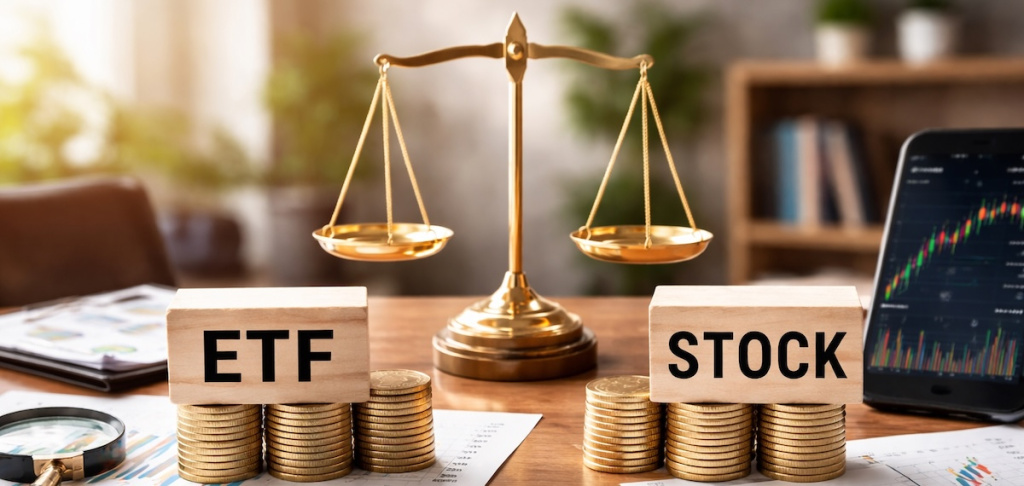
Shares or ETFs: what should an investor choose?
ETFs are suitable for investors who want diversified access to a market, sector or asset class through one instrument. This is a convenient solution for long-term investing, regular purchases and building a balanced portfolio.
In practice, shares and ETFs may complement each other. For example, the core of a portfolio may consist of broad index ETFs, while individual shares may be used for targeted investment ideas in companies that the investor understands well.
Conclusion
When choosing an instrument, it is important to look not only at potential return, but also at liquidity, currency, country risk, tax consequences, regulation, market accessibility and overall costs.
A properly chosen market and correctly selected instruments help an investor not simply buy securities, but build a clear, diversified and manageable investment strategy.